1982-11-30-Lexington_Herald_Leader_3
If it's true that great warriors can choose the way they die, then Pete Townshend and The Who are bowing out of major rock touring as great warriors should.
The band has said that its current U.S. road show is its last major tour, and Monday night's sold-out concert at Rupp Arena came off just the way the English supergroup planned it.
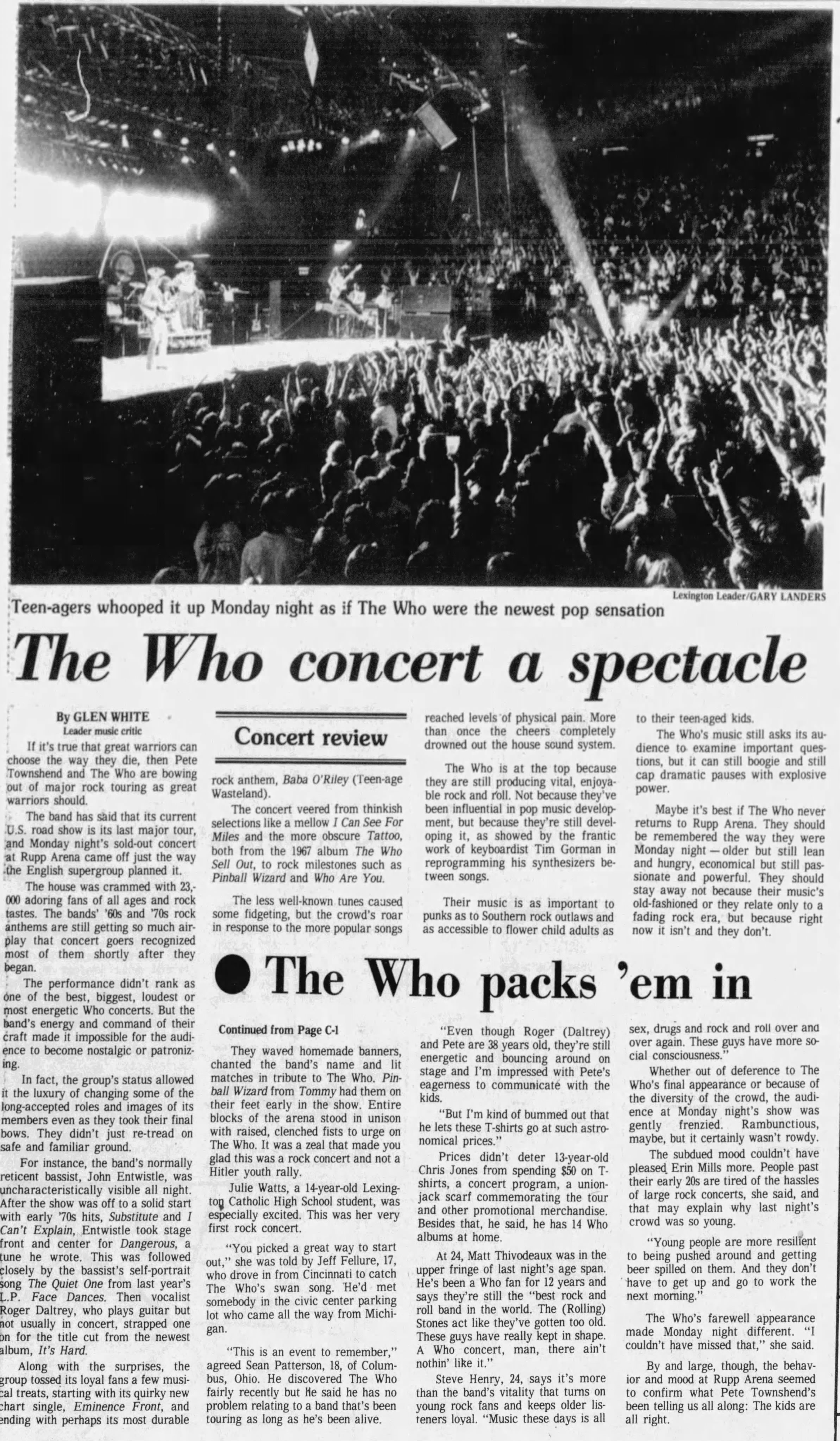
The house was crammed with 23,000 adoring fans of all ages and rock tastes. The band's '60s and '70s rock anthems are still getting so much airplay that concert goers recognized most of them shortly after they began.
The performance didn't rank as one of the best, biggest, loudest or most energetic Who concerts. But the band's energy and command of their craft made it impossible for the audience to become nostalgic or patronizing.
In fact, the group's status allowed it the luxury of changing some of the long-accepted roles and images of its members even as they took their final bows. They didn't just re-tread on safe and familiar ground.
For instance, the band's normally reticent bassist, John Entwistle, was uncharacteristically visible all night. After the show was off to a solid start with early '70s hits, "Substitute" and "I Can't Explain," Entwistle took stage front and center for "Dangerous," a tune he wrote. This was followed closely by the bassist's self-portrait song "The Quiet One" from last year's L.P. Face Dances. Then vocalist Roger Daltrey, who plays guitar but not usually in concert, strapped one on for the title cut from the newest album, It's Hard.
Along with the surprises, the group tossed its loyal fans a few musical treats, starting with its quirky new chart single, "Eminence Front," and ending with perhaps its most durable rock anthem, "Baba O'Riley (Teen-age Wasteland)."
The concert veered from thinkish selections like a mellow "I Can See For Miles" and the more obscure "Tattoo," both from the 1967 album The Who Sell Out, to rock milestones such as "Pinball Wizard" and "Who Are You."
The less well-known tunes caused some fidgeting, but the crowd's roar in response to the more popular songs reached levels of physical pain. More than once the cheers completely drowned out the house sound system.
The Who is at the top because they are still producing vital, enjoyable rock and roll. Not because they've been influential in pop music development, but because they're still developing it, as showed by the frantic work of keyboardist Tim Gorman in reprogramming his synthesizers between songs.
Their music is as important to punks as to Southern rock outlaws and as accessible to flower child adults as to their teen-aged kids.
The Who's music still asks its audience to examine important questions, but it can still boogie and still cap dramatic pauses with explosive power.
Maybe it's best if The Who never returns to Rupp Arena. They should be remembered the way they were Monday night - older but still lean and hungry, economical but still passionate and powerful. They should stay away not because their music's old-fashioned or they relate only to a fading rock era, but because right now it isn't and they don't.
They waved homemade banners, chanted the band's name and lit matches in tribute to The Who. "Pinball Wizard" from Tommy had them on their feet early in the show. Entire blocks of the arena stood in unison with raised, clenched fists to urge on The Who. It was a zeal that made you glad this was a rock concert and not a Hitler youth rally.
Julie Watts, a 14-year-old Lexington Catholic High School student, was especially excited. This was her very first rock concert.
"You picked a great way to start out," she was told by Jeff Fellure, 17, who drove in from Cincinnati to catch The Who's swan song. He'd met somebody in the civic center parking lot who came all the way from Michigan.
"This is an event to remember," agreed Sean Patterson, 18, of Columbus, Ohio. He discovered The Who fairly recently but he said he has no problem relating to a band that's been touring as long as he's been alive.
"Even though Roger (Daltrey) and Pete are 38 years old, they're still energetic and bouncing around on stage and I'm impressed with Pete's eagerness to communicate with the kids.
"But I'm kind of bummed out that he lets these T-shirts go at such astronomical prices."
Prices didn't deter 13-year-old Chris Jones from spending $50 on T-shirts, a concert program, a union-jack scarf commemorating the tour and other promotional merchandise. Besides that, he said, he has 14 Who albums at home.
At 24, Matt Thivodeaux was in the upper fringe of last night's age span. He's been a Who fan for 12 years and says they're still the "best rock and roll band in the world. The (Rolling) Stones act like they've gotten too old. These guys have really kept in shape.
A Who concert, man, there ain't nothin' like it."
Steve Henry, 24, says it's more than the band's vitality that turns on young rock fans and keeps older listeners loyal. "Music these days is all sex, drugs and rock and roll over and over again. These guys have more social consciousness."
Whether out of deference to The Who's final appearance or because of the diversity of the crowd, the audience at Monday night's show was gently frenzied. Rambunctious, maybe, but it certainly wasn't rowdy.
The subdued mood couldn't have pleased Erin Mills more. People past their early 20s are tired of the hassles of large rock concerts, she said, and that may explain why last night's crowd was so young.
"Young people are more resilient to being pushed around and getting beer spilled on them. And they don't have to get up and go to work the next morning."
The Who's farewell appearance made Monday night different. "I couldn't have missed that," she said.